


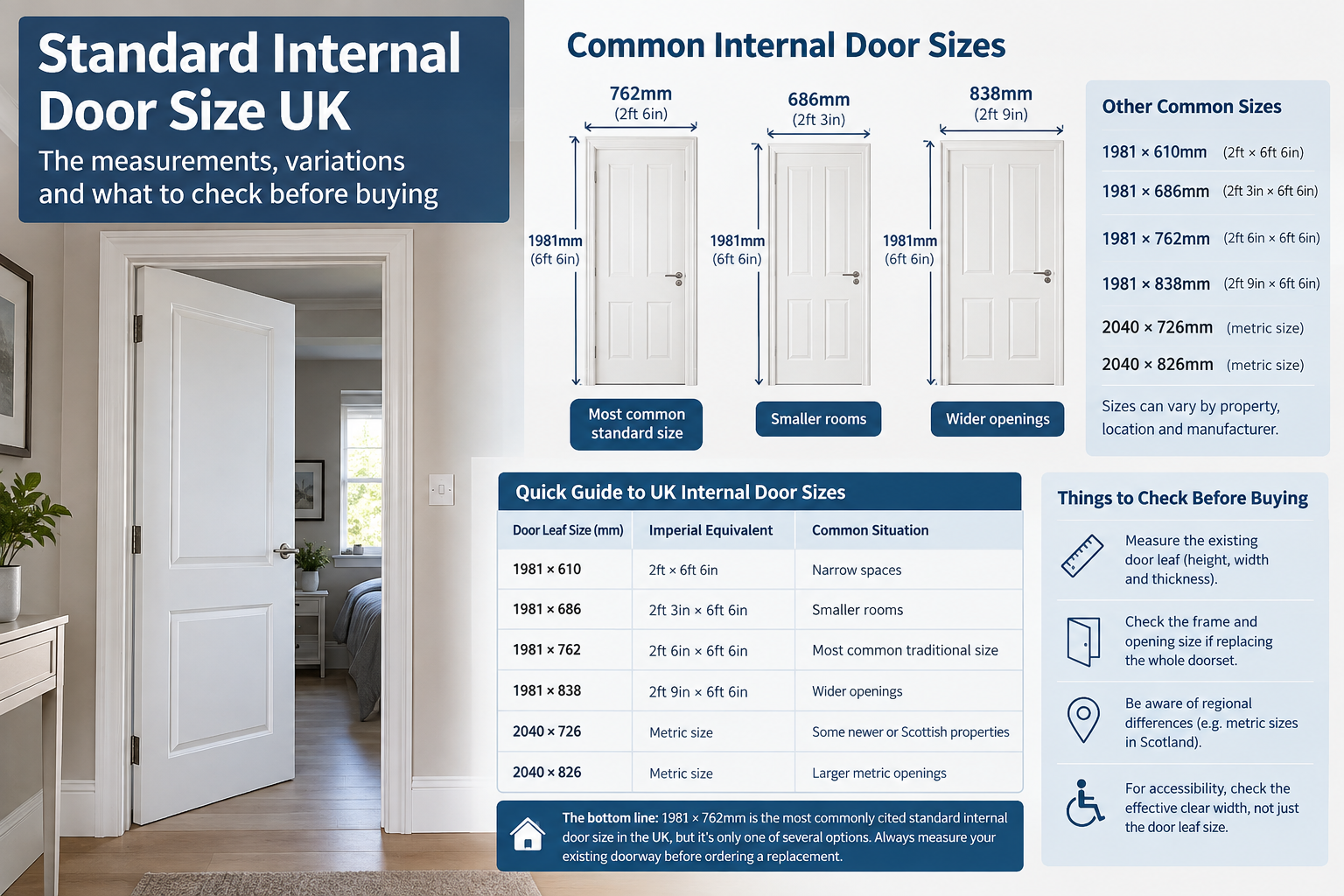
A “standard” internal door in the UK is not actually one universal measurement. The familiar 1981 × 762mm door remains one of the most common sizes, but other widths and metric dimensions are widely used.
The mystery starts with a simple question: what exactly does “standard internal door size UK” mean?
Table of Contents
ToggleThe most common UK internal door size
For many homes in England and Wales, the measurement most closely associated with a standard internal door is 1981mm high × 762mm wide × approximately 35mm thick.
That converts to roughly 6ft 6in × 2ft 6in, commonly described as a “2’6 door”. Door-industry guides identify this as the most common traditional internal door leaf size in England and Wales.
But calling it the only standard would be misleading.
Common alternatives include 1981 × 610mm, 1981 × 686mm, and 1981 × 838mm. The choice can depend on the room, available space, age of the property and the existing frame.
Why 1981mm appears so often
The 1981mm measurement is the metric equivalent of the traditional 6ft 6in internal door height.
Older UK housing stock frequently uses this imperial-derived sizing system. Although doors are now normally specified in millimetres, the old measurements remain embedded in the sizes manufacturers continue to produce.
A 762mm-wide door, for example, is effectively the old 30-inch-wide door. That is why homeowners can encounter both metric and imperial descriptions for what is essentially the same door leaf.
The main standard sizes to know
The most useful starting point is the door leaf itself rather than the entire doorway.
A typical selection looks like this:
| Door leaf size | Imperial equivalent | Common situation |
|---|---|---|
| 1981 × 610mm | 2ft × 6ft 6in | Narrow spaces |
| 1981 × 686mm | 2ft 3in × 6ft 6in | Smaller rooms |
| 1981 × 762mm | 2ft 6in × 6ft 6in | Most common traditional size |
| 1981 × 838mm | 2ft 9in × 6ft 6in | Wider openings |
| 2040 × 726mm | Metric size | Some newer or Scottish properties |
| 2040 × 826mm | Metric size | Larger metric openings |
These are common examples rather than a complete national list. Manufacturers offer additional sizes, and individual properties can contain openings that fall outside the usual range.
The Scotland question
One detail that can easily complicate the search is geography.
The traditional 1981mm-high imperial door is particularly associated with England and Wales. Metric-sized doors, including 2040 × 726mm, are commonly encountered in Scotland and in some newer construction.
That means a homeowner searching for the “UK standard” can receive different answers depending on the property and location.
There is therefore no single measurement that can safely be assumed for every British home.
Door size is not the same as opening size
This is where many replacement-door mistakes happen.
A measurement such as 1981 × 762mm normally describes the door leaf, not necessarily the size of the hole in the wall or the complete frame.
The frame, lining, stops, hinges, floor covering and installation tolerances all affect the finished opening. A planning document, for example, records a 762 × 1981mm door leaf alongside a larger structural opening, demonstrating why the two measurements should not be treated as interchangeable.
So measuring the existing doorway is essential before ordering a replacement.
What about accessibility?
The wider 838mm internal door is frequently associated with improved access, but there is an important distinction.
Accessibility requirements generally concern the effective clear width available when the door is open, rather than simply the nominal width of the door leaf.
England’s Approved Document M, for example, specifies minimum effective clear widths for relevant accessible routes. For certain new-building situations, the requirement is 800mm, with the exact figure depending on the approach to the doorway.
That means it would be inaccurate to say that every 838mm door automatically satisfies every accessibility requirement. The complete doorway arrangement has to be considered.
How to measure before ordering
The safest approach is to measure the existing door rather than relying on a description such as “bedroom door” or “standard UK door.”
Measure the height and width of the existing door leaf, then check its thickness. If replacing the complete doorset, measure the frame and opening separately.
For width, checking more than one point can reveal whether the frame is slightly out of square. Supplier guidance also recommends checking the actual manufacturer dimensions before ordering.
Period properties deserve particular caution. Older houses can contain altered, unusually sized or bespoke openings, meaning a supposedly standard replacement may not fit without modification.
So what is the standard internal door size UK?
The evidence points to a straightforward answer with an important qualification.
1981 × 762mm is the most commonly cited traditional standard internal door size in England and Wales, usually around 35mm thick. But it is only one of several commonly manufactured dimensions.
The real answer for any individual home depends on the existing opening, the door frame, the property’s age, location and whether particular access or fire requirements apply.
In other words, the “standard” is a useful starting point — not a substitute for measuring the doorway.
About the Author
James Carter is a home and property journalist specialising in practical UK housing, renovation and building topics. His work focuses on translating technical specifications and regulations into clear information for homeowners.
